Socrates, Plato, and Aristotle: A Beginner’s Guide to Greek Thought
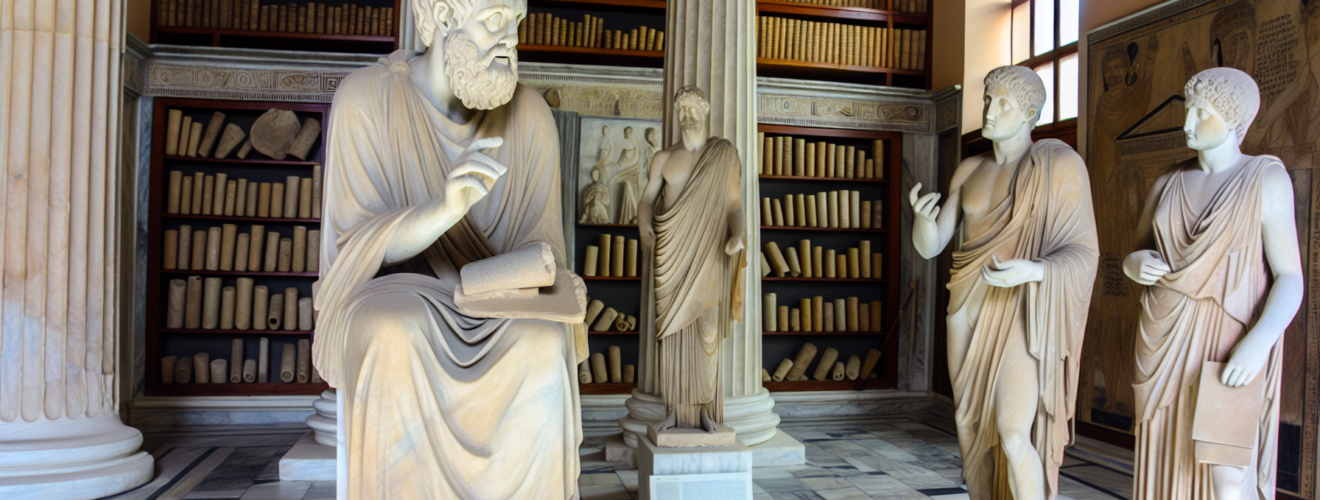
Socrates, Plato, and Aristotle stand at the start of Western philosophy. They wrote, taught, and argued in Athens during a time of war, trade, and quick political change. Their ideas can feel distant, yet their questions are still familiar. What is a good life? What is truth? How should a city be run? This brief guide explains their core aims and shows how their work fits together.
Greek thought did not begin with them, but they shaped what came after. Socrates focused on how to live well. Plato built a wide system around knowledge and justice. Aristotle then studied nature, logic, and ethics with careful method. Read as a sequence, they offer a clear path from questions, to theories, to practical inquiry.
Why These Three Matter
Many ancient thinkers wrote about the world, but these three set an enduring model for philosophy as reasoned discussion. They treated argument as a shared task, not a private opinion. They also linked thought to education. Each one, in a different way, asked readers to examine beliefs and to give reasons for them.
They also formed a line of influence. Socrates taught Plato through conversation and example. Plato later founded the Academy, where Aristotle studied for many years. Their works disagree on key points, yet the disagreements helped define major fields such as ethics, politics, metaphysics, and logic.
Socrates: Philosophy as Questioning
Socrates left no writings of his own. What we know comes mainly from Plato and a few other sources. In these accounts, Socrates walks through Athens and speaks with citizens, poets, and leaders. He does not present a finished doctrine. Instead, he tests claims through sustained questioning.
A central aim of Socrates is clarity about moral terms. People say they value justice, courage, or piety, yet they often cannot define them. Socrates presses for definitions that hold in many cases, not just one example. This method is now called the Socratic method. It uses short questions to reveal hidden assumptions and to expose weak reasoning.
Socrates also argues that the examined life is best for human beings. He links knowledge and virtue: if one truly knows what is good, one will choose it. In practice, this claim is demanding. It suggests that wrongdoing is tied to ignorance, not only to appetite or malice. His trial and execution, described in Plato’s dialogues, made him a lasting symbol of intellectual integrity and civic tension.
Plato: Forms, Knowledge, and the Just City
Plato wrote philosophical dialogues, many of which feature Socrates as the main speaker. The dialogue form matters. Plato shows philosophy as a living exchange, where positions improve through critique. Yet Plato also advances clear views about reality and knowledge.
In several works, Plato distinguishes between the changing world we sense and a stable realm of Forms. A Form is an intelligible pattern, such as Justice itself or Equality itself. Particular things are imperfect copies. For Plato, genuine knowledge concerns these Forms, because they do not change. Sense perception, by contrast, often yields shifting opinion.
Plato’s famous Allegory of the Cave illustrates this contrast. Prisoners mistake shadows for reality until one turns toward the light. The story suggests that education is a turning of the soul. It also implies that truth may conflict with common belief and with political comfort.
In the Republic, Plato links knowledge to rule. A well-ordered city needs leaders who grasp what justice is, not leaders who chase wealth or honor. This view supports the ideal of the philosopher-ruler. Readers may reject Plato’s strict social structure, but his core problem remains pressing: how can political power be guided by reason rather than by appetite, fear, or faction?
Aristotle: Method, Nature, and Practical Wisdom
Aristotle studied in Plato’s Academy but later developed his own approach. He wrote treatises rather than dialogues, and his tone is often analytic. Aristotle is less focused on a separate realm of Forms. He looks instead to the structures within the natural world and within human practices.
One of Aristotle’s key contributions is logic, especially the study of valid inference. He also stresses careful classification in biology and other sciences. For Aristotle, knowledge grows from observation, comparison, and explanation. He asks what a thing is, what it is for, and how it changes.
In ethics, Aristotle argues that the human good is eudaimonia, often translated as flourishing. Flourishing is not a passing feeling. It is a stable life of excellent activity. Moral virtue, on his view, is a trained disposition to feel and act in the right way. He describes virtue as a mean between extremes, such as courage between rashness and cowardice.
Aristotle also emphasizes practical wisdom, or phronesis. Rules alone cannot settle every case, because life is complex. A wise person learns to judge what fits the situation. In politics, Aristotle studies real constitutions and asks which aims they serve. His work connects ethics and civic life: good laws can shape character, and good character supports good laws.
How Their Ideas Fit Together
Socrates begins with moral urgency and the demand for reasons. Plato builds a theory of knowledge that explains why reason should guide life and politics. Aristotle then grounds philosophy in method, evidence, and practical judgment. Each takes up a shared set of questions, yet each changes the tools used to answer them.
For beginners, the most useful lesson is their shared discipline. They model patience with hard problems and respect for argument. Their disagreements also teach a key academic habit: to treat a view as something to test, not something to repeat. In that sense, Greek philosophy is less a list of conclusions than a way of thinking that still invites participation.