The Silk Road: How Ancient Trade Shaped the Modern World
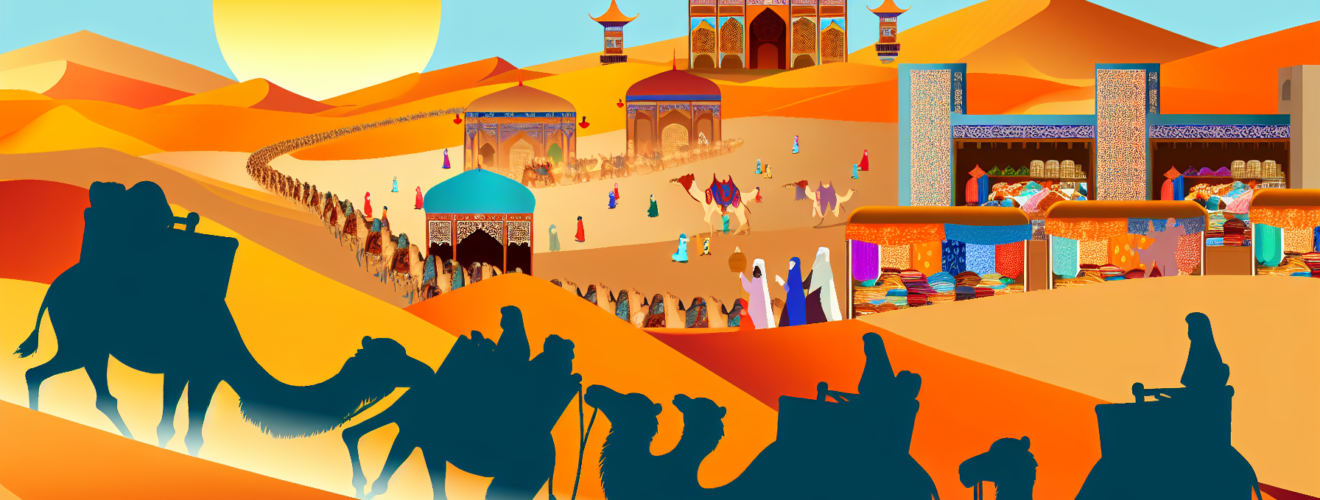
The Silk Road was not one road. It was a wide network of land and sea routes that linked East Asia, Central Asia, the Middle East, Africa, and Europe. From about 200 BCE to 1500 CE, it moved goods, people, and ideas across long distances. Its effects did not end when empires fell or routes shifted. Many features of the modern world, from global trade to shared knowledge, grew from patterns first shaped on these routes.
Today, supply chains cross borders, cities depend on imports, and new ideas spread fast. These are modern forms of the same forces that drove the Silk Road. Distance, risk, and profit pushed merchants to innovate. States learned to tax, protect, and compete for trade. Communities adapted as new foods, beliefs, and skills arrived. The Silk Road helps explain how contact and exchange can build long-term change.
Origins and Structure of the Silk Road
The Silk Road emerged as large states expanded and sought reliable links. The Han dynasty in China opened routes through the Gansu corridor toward Central Asia. At the same time, Parthian, Kushan, and later Sogdian actors managed key stretches in between. No single empire controlled the whole system for long. Instead, trade worked through many handoffs, with goods changing owners across oases, ports, and mountain passes.
Geography shaped how trade worked. Deserts such as the Taklamakan and high ranges such as the Pamirs made travel costly. Caravans moved in stages from one safe point to another. Oases like Kashgar, Samarkand, and Merv became hubs for storage, repair, and credit. In the south, maritime routes in the Indian Ocean linked China and Southeast Asia with India, Arabia, and East Africa. Together, land and sea paths formed a flexible system that could shift when war, climate, or policy changed.
Goods, Markets, and Economic Innovation
Silk gave the network its famous name, but trade was diverse. China exported silk, lacquerware, ceramics, and later paper and gunpowder-related materials. From Central and Western Asia came horses, wool, glass, metalwork, and precious stones. India supplied spices, cotton textiles, and medicines. The Roman and later Byzantine worlds sent glassware, coins, and luxury items. Many goods were not luxuries. Grain, salt, and timber moved locally, while long-distance trade focused on items with high value per weight.
Trade at this scale required new economic tools. Merchants needed partnerships to share risk, since raids, storms, and political change were common. They relied on contracts, loans, and early forms of bills of exchange. States built roads, forts, and caravanserais to attract commerce and collect revenue. Customs taxes and market fees became major sources of income. These practices helped normalize the idea that governments could grow stronger by enabling trade, a principle that still shapes economic policy.
Ideas, Religions, and Knowledge Transfer
The Silk Road carried beliefs as well as products. Buddhism spread from India into Central Asia and China, supported by monks, patrons, and translators. Later, Islam expanded across Central Asia, bringing new legal ideas, scholarly networks, and artistic styles. Christianity also traveled along these routes in several forms. Religious exchange was not always peaceful, but the network created many contact zones where debate, translation, and adaptation were possible.
Science, Technology, and Learning
Knowledge moved through travel, trade, and migration. Papermaking reached West Asia and then Europe, which lowered the cost of writing and record keeping. Techniques in irrigation, metallurgy, and textile production spread in many directions. Mathematical and astronomical ideas traveled between Indian, Persian, Arab, and later European scholars. Over time, urban centers on the Silk Road became sites where languages mixed and practical knowledge was tested in markets, workshops, and courts.
Migration, Cities, and Cultural Blending
Trade routes encouraged movement. Merchants formed diaspora communities, often living in foreign cities for long periods. These groups built temples, markets, and legal norms that helped them do business across borders. Intermarriage and bilingualism were common in hub cities. Art and design show this blending: Buddhist sculpture took on Hellenistic features in Gandhara, while Chinese motifs appeared in Persian metalwork and textiles.
Cities grew where routes met. They offered security, services, and demand. In return, they attracted artisans, scholars, and officials. Urban life on the Silk Road depended on water management, stable taxation, and diplomacy with neighbors. These needs pushed states to invest in administration and infrastructure. Modern global cities play a similar role, acting as gateways where finance, logistics, and culture concentrate.
Conflict, Disease, and the Limits of Connectivity
Connectivity brought harm as well as benefit. Control of trade could trigger conflict. Empires fought for passes, ports, and tribute. Banditry and local rivalries added constant risk. Merchants responded with armed escorts, alliances, and route changes. These dynamics resemble modern struggles over chokepoints, sanctions, and trade security.
Diseases also traveled. The Black Death in the fourteenth century spread along trade links that connected East and West. While historians debate exact paths, the broader lesson is clear: exchange can move pathogens as well as products. The long history of the Silk Road shows that public health is tied to mobility, and that economic networks can amplify crises when monitoring and response are weak.
Legacy in the Modern World
The Silk Road shaped a model of long-distance exchange that still matters. It strengthened the role of intermediaries, finance, and logistics. It encouraged states to compete for transit revenue and to build infrastructure that supported commerce. It also proved that ideas travel best when people have reasons to meet, trade, and translate. In this sense, the Silk Road was an early engine of globalization.
Modern trade networks are faster and larger, but they share key traits with the ancient system: dependence on stable routes, trust across cultures, and the constant balance between openness and risk. Studying the Silk Road clarifies how deeply the modern world depends on patterns formed over centuries. It reminds us that globalization is not new, and that today’s connections, like those of the past, can create both shared opportunity and shared vulnerability.