Ancient Civilizations: Comparing Mesopotamia, Egypt, and the Indus Valley
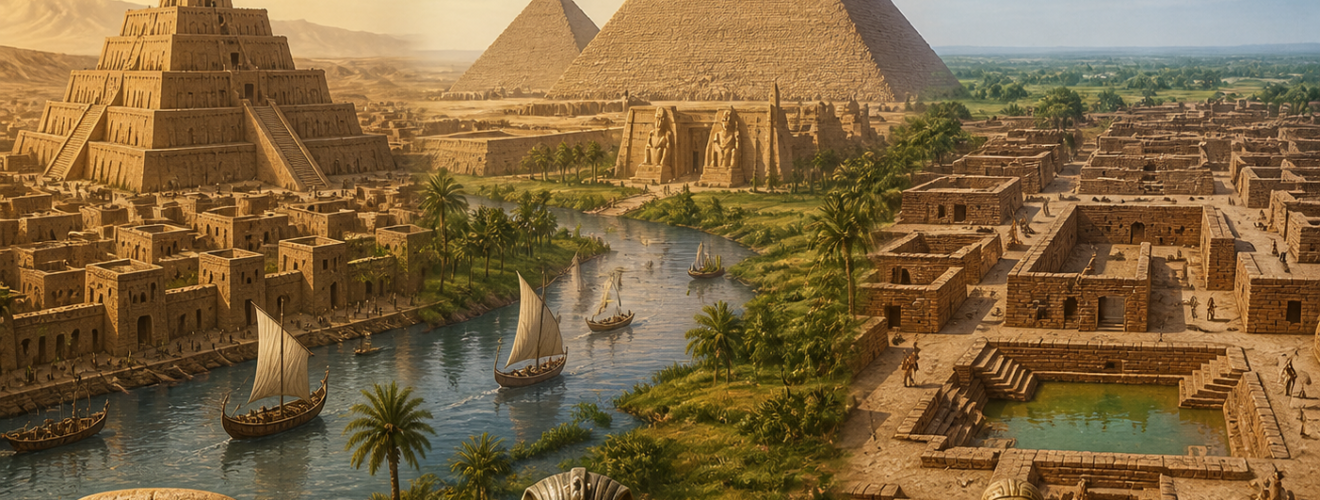
The study of early human groups shows how we first built large societies. These groups grew in river valleys thousands of years ago. The three most famous areas were Mesopotamia, Egypt, and the Indus Valley. Each group rose near a large source of fresh water. This water was vital for crops and for moving goods. While these groups were far apart, they shared many traits. They all had clear laws and social ranks. They also built massive structures that we still study today. However, the land around them shaped their lives in unique ways. This article will compare these three great cultures. It will show how they were alike and how they were different.
Geography and Environment
Land and water played a major role in how these groups lived. Mesopotamia sat in a place called the Fertile Crescent. It was the land between the Tigris and the Euphrates rivers. These rivers were hard to predict. They flooded at different times each year. This made farming a hard task. People had to work together to build dams and canals. In contrast, Egypt lived by the Nile River. The Nile was very steady. It flooded at the same time every year. This helped the Egyptians plan their food supply with ease. It also gave them a happy view of the world and the gods. They felt the earth was a stable place. The Indus Valley was in what is now Pakistan and India. The Indus River gave the people rich soil. The high mountains and wide deserts nearby kept them safe. These natural walls helped the group grow in peace for a long time.
The Impact of Rivers
Rivers were the life blood of these early states. They provided water for the desert heat. They also acted as roads. Boats could move food and stone over long distances. In Mesopotamia, the rivers could be violent. This led to a religion where the gods were seen as moody. In Egypt, the Nile was a gift. It was a kind force that gave life to the sand. The Indus River was also a friend to the people. It allowed for large cities to grow in a dry land. Without these rivers, these groups would not have existed.
Political Systems and Authority
The way these groups were ruled varied quite a bit. Mesopotamia was made of many city-states. Cities like Ur and Babylon had their own kings. These kings often fought each other for land and water. One famous leader was Hammurabi. He wrote a set of laws to keep order. His code was very strict and focused on justice. In Egypt, the ruler was the Pharaoh. The Pharaoh was not just a leader. He was seen as a god on earth. This meant the Pharaoh had total power over the land. The government was very stable for many centuries. The Indus Valley is more of a mystery to us today. We see no large statues of kings or queens. We also see no signs of a large army. Yet, the cities were perfectly planned. This suggests a strong central power was at work. It is likely that a group of priests or traders ran the cities. They focused on trade and peace rather than war. This made their path very different from the other two groups.
Laws and Order
Order was a key goal for all three societies. In Mesopotamia, laws were carved in stone for all to see. This made the rules clear. In Egypt, the word of the Pharaoh was the law. People obeyed because they respected the divine order of the world. In the Indus Valley, order is seen in the streets. Every house was built in a neat grid. Every brick was the same size. This shows a high level of social control. Even without a king we can name, the people followed a strict plan. This helped their cities last for a long time.
Social Hierarchy and Roles
Social levels were a major part of ancient life. At the top were the rulers and the priests. They held the most wealth and power. Below them were the scribes and the workers. Scribes were very important people. They were the ones who could read and write. They kept records of taxes and grain. This was vital for a large state. Artisans made pottery, jewelry, and tools for the city. The largest group was the farmers. They worked the soil to feed everyone. At the bottom of the ladder were the enslaved people. In Egypt, social levels were somewhat fluid. A smart person from a poor home could become a scribe. They could then rise to a high rank. In Mesopotamia, your role was often fixed at birth. This kept the system stable but made it hard for people to change their lives. The Indus Valley also had ranks. We see this in the size of the houses. Some were large, while others were small. This shows that some people were richer than others.
Science and Urban Planning
Each group made great leaps in science and art. Mesopotamia gave us the first writing called cuneiform. They used reeds to make marks on wet clay. They also studied the stars and the moon. This helped them make a calendar with twelve months. We still use their system of time today. Egypt is famous for the great pyramids. These tombs show that they knew a lot about math. They also used hieroglyphs to record their history. The Indus Valley was the most advanced in city design. They used a grid system for their streets. They also had a system of pipes for water and waste. This was the first known sewer system in the world. They even had private baths in their homes. This shows they cared a lot about health and being clean. They used standard weights for trade as well. This made buying and selling very fair for everyone.
Trade and Interaction
Trade was a bridge between these distant lands. These groups did not live alone. Mesopotamia and the Indus Valley traded with each other. We know this because Indus seals have been found in Sumerian cities. They traded items like copper, gold, and beads. Egypt traded with lands to the south and the east. They wanted wood, incense, and rare stones. These trade routes were not just for goods. They were also for sharing ideas. People told stories and shared ways of building. This trade made the groups very wealthy. It also helped them survive if their own crops failed. The sea and the rivers were the main paths for this trade. They made it possible for these cultures to grow and learn from one another. This link helped spread new tools and styles across the ancient world.
Legacy and Conclusion
The legacy of these three groups is still with us. Mesopotamia gave us the wheel and the first written laws. Egypt gave us wonders of building and a calendar based on the sun. The Indus Valley showed us how to plan a city and keep it clean. Each group faced the same basic tasks. They had to manage water, feed people, and keep the peace. Their different ways of doing this shaped the start of human history. By looking at them together, we see the beauty of human growth. They all started with a river and a hope for a better future. Today, we still live in the world they helped to build. Their stories tell us where we came from and how we learned to live together in large groups.
Sources
Algaze, G. (2005). The Uruk world system: The dynamics of expansion of early Mesopotamian civilization. University of Chicago Press.
Bard, K. A. (2015). An introduction to the archaeology of Ancient Egypt. Wiley-Blackwell.
Kenoyer, J. M. (1998). Ancient cities of the Indus Valley civilization. Oxford University Press.
McIntosh, J. R. (2008). The ancient Indus Valley: New perspectives. ABC-CLIO.
Van De Mieroop, M. (2015). A history of the Ancient Near East, ca. 3000-323 BC. Wiley-Blackwell.