Pre-Colonial Social Classes: Maharlika, Timawa, and Alipin
The history of the Philippines before the Spanish arrived is rich and complex. Scholars often look at the social ranks of that time to understand how people lived. These ranks were not just about wealth. They were about duty, honor, and the roles people played in their small towns. These towns were called barangays. Each barangay was a small group led by a chief. The system of social classes helped keep order and peace. It allowed the group to work together for food and safety. By looking at these classes, we can see a world that was very organized. This world had clear laws and rights for almost everyone. The three main groups were the Maharlika, the Timawa, and the Alipin. Each group had a specific place in the life of the community.
The Structure of the Barangay
The barangay was the basic unit of the early Philippine state. It was usually made up of thirty to one hundred families. At the top of this group was the Maginoo class. The leader of the group was the Datu. The Datu came from the Maginoo class. He was the judge, the leader in war, and the protector of the people. People respected the Datu because of his bloodline and his wisdom. He did not rule with total power. He had to follow the customs and laws of the group. The other social classes lived under his care. In exchange, they helped him with tasks and joined him in battle. This created a sense of unity. Everyone knew what they had to do to help the group survive. The social structure was not as stiff as some might think. People could sometimes move from one rank to another. This movement depended on luck, hard work, or marriage. Understanding the Maginoo is the first step to seeing how the other classes fit in.
The Maharlika: The Noble Warrior Class
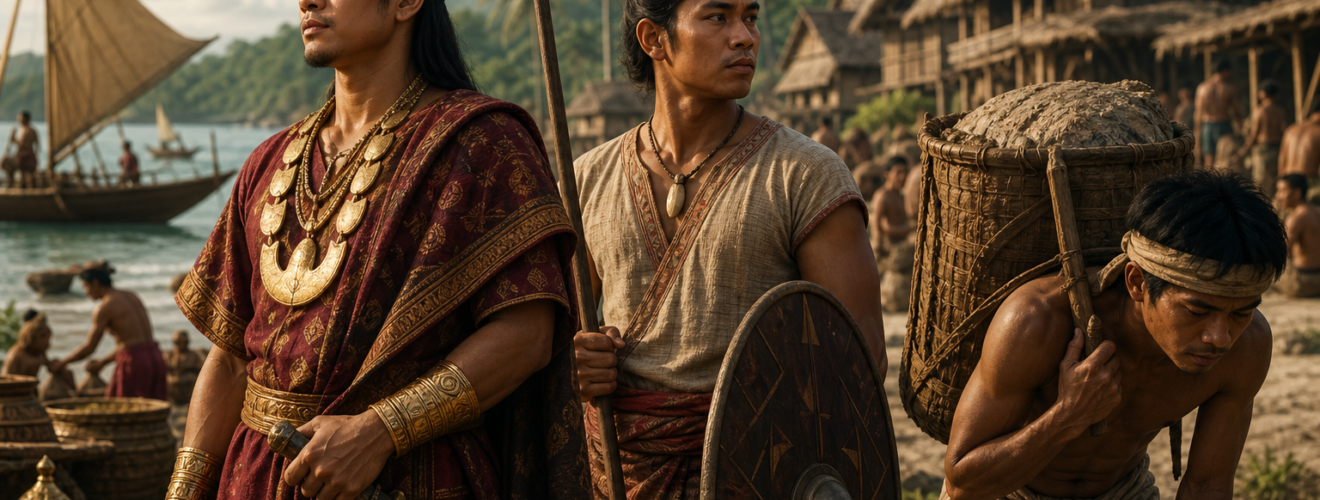
The Maharlika were a very special group in Tagalog society. They are often called the noble warriors. Their main job was to provide military service to the Datu. Unlike other groups, the Maharlika did not pay taxes or give a share of their crops. Instead, they gave their lives and their skills in battle. When the Datu went to war, the Maharlika went with him. They had to provide their own weapons and gear. This included swords, shields, and boats. Their status was tied to their skill as fighters and their loyalty to the leader. Because they were free, they had high social standing. However, they were still under the Datu. They could not easily leave their leader to join another without a special ceremony. This bond of loyalty was the heart of the Maharlika class. They were the defenders of the community.
Rights and Duties of the Maharlika
The Maharlika had many rights that set them apart. They could own land and had their own houses. They could also have servants to help them with their daily needs. Their primary duty was not just fighting in wars. They also helped the Datu with official tasks. For example, they might help build the Datu’s house or help him fish. Even though they did not pay tribute, they were expected to give gifts to the Datu during feasts. Their lives were defined by a code of honor. This code required them to be brave and faithful. If a Maharlika failed in his duty, he could lose his status. This shows that their rank was based on merit as much as it was based on birth. They were the elite force that kept the barangay safe from outside threats.
The Timawa: The Free People
The Timawa were the common people who were born free. In many ways, they were the backbone of the barangay. They were neither nobles nor servants. Most of the people in the village belonged to this class. They had the right to own land and to engage in trade. They could marry whoever they wanted from their own class or even higher classes if allowed. The Timawa did not have the same military duties as the Maharlika. However, they still supported the Datu. They would help with the harvest or join fishing trips. They were also called upon to help with labor for the community. Their role was to keep the economy moving. They grew the food and made the goods that everyone needed. They were a stable and vital part of early Philippine life.
Social Mobility of the Timawa
One interesting thing about the Timawa was their freedom to move. They could choose which Datu to follow. If they were not happy with their leader, they could move to a different barangay. This gave them some level of power. The Datu had to treat them well to keep them in his village. The Timawa could also rise in rank. A very successful Timawa could become a respected member of the community. In some cases, they might even gain enough wealth to be seen as near the noble class. This flexibility is a key feature of early Philippine society. It was not a rigid system of castes like in some other parts of Asia. Instead, it was a system based on mutual needs and respect. The Timawa lived lives of dignity and hard work.
The Alipin: The Servant Class
At the bottom of the social ladder were the Alipin. It is important to know that “Alipin” does not mean “slave” in the way we often think of it today. In the Western world, slavery often meant being owned like a piece of property forever. In the pre-colonial Philippines, being an Alipin was often a temporary state. People became Alipin for several reasons. The most common reason was debt. If a person could not pay back what they owed, they became an Alipin to the lender. Others became Alipin as a punishment for a crime or because they were captured in a war. However, they still had rights. They were seen as people, not objects. There were two main types of Alipin: the Alipin Namamahay and the Alipin Saguiguilid. These two groups had very different lives.
Alipin Namamahay
The Alipin Namamahay were the householders. They were quite free compared to the other type of Alipin. They lived in their own homes and had their own families. They could own land and keep the money they earned from their work. Their main duty was to serve the Datu or their master during specific times. For example, they might help during the planting season or help build a house. They were not required to stay in their master’s house. In many ways, they were more like tenants than slaves. They had a stake in the community and could work their way out of debt. Once the debt was paid, they could return to being Timawa. This shows that the system focused on justice and the repayment of debts rather than total control.
Alipin Saguiguilid
The Alipin Saguiguilid had a harder life. These were the hearth-servants. They lived in the house of their master and served them daily. They usually did not have their own property or land. They relied on their master for food and shelter. Many Alipin Saguiguilid were people who had been captured in war. Others were born into this rank because their parents were Alipin Saguiguilid. Even so, they could still earn their freedom. If they saved enough money, they could buy their way out of service. They could also be set free by their master as a gift. While their life was restricted, they were still protected by the laws of the barangay. A master could not kill his Alipin without a very good reason. The system was designed to maintain social order while giving everyone a chance to improve their life.
Conclusion
The social classes of the pre-colonial Philippines were complex and balanced. The Maharlika provided protection, the Timawa provided labor and stability, and the Alipin filled the roles of service and debt repayment. This structure allowed the barangay to thrive for centuries. When the Spanish arrived, they changed many of these rules. They tried to fit the local system into their own European ideas of royalty and peasants. However, the legacy of these early ranks still lives on in the way we view Filipino history. It shows a society that valued duty, community, and the possibility of growth. By studying the Maharlika, Timawa, and Alipin, we gain a better view of the true roots of the Filipino people. We see a past that was fair, organized, and full of life.
Sources
Agoncillo, T. A. (1990). History of the Filipino People (8th ed.). Garotech Publishing.
Jocano, F. L. (1998). Filipino Prehistory: Rediscovering Precolonial Heritage. Punlad Research House.
Scott, W. H. (1994). Barangay: Sixteenth-Century Philippine Culture and Society. Ateneo de Manila University Press.
Zaide, S. M. (1999). The Philippines: A Unique Nation. All-Nations Publishing Co.