The Tragedy of the Commons: Managing Shared Resources
The concept of the tragedy of the commons is a vital part of modern science. It helps us see how we use shared resources. This idea first became famous in 1968. An ecologist named Garrett Hardin wrote a paper about it. He looked at what happens when many people use the same resource. His work showed a deep conflict. This conflict is between what is good for one person and what is good for the whole group. When people act only for themselves, they can destroy the things everyone needs to survive. This problem touches many parts of our lives today. We see it in our oceans, our air, and even the internet. Understanding this concept is the first step toward finding better ways to live together on our planet.
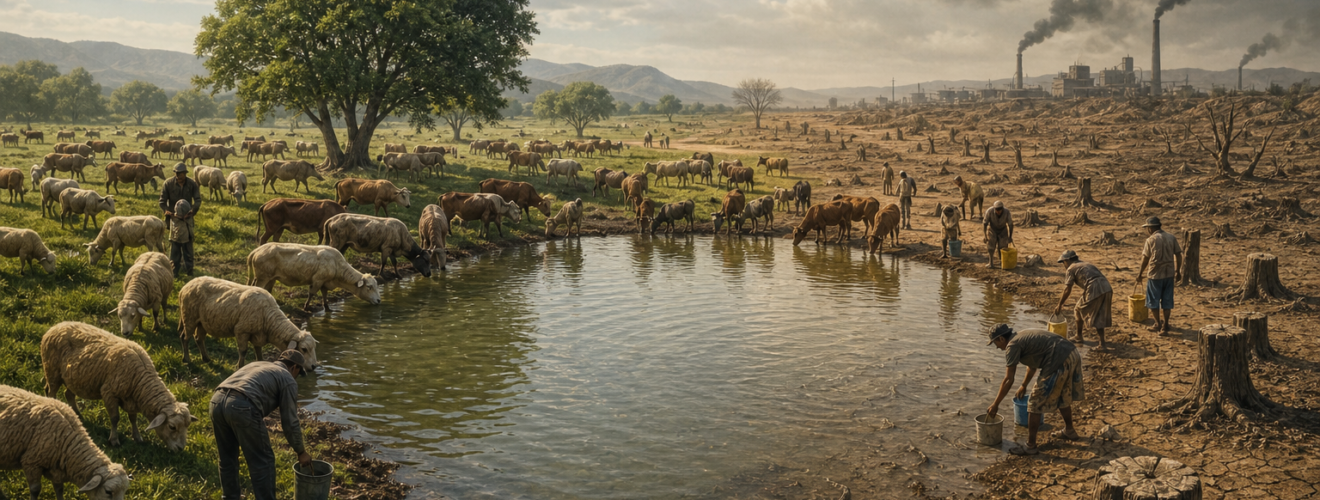
The root of the tragedy is simple logic. Imagine a large field of green grass that is open to all. Several farmers use this field to feed their cows. Each farmer wants to make as much money as possible. To do this, a farmer might want to add one more cow to the field. Adding a cow brings a clear benefit to that one farmer. He gets to sell more milk or meat. However, the cost of the extra cow is shared by everyone. The grass is eaten a bit faster. The soil becomes a bit weaker. If only one farmer adds a cow, the field stays healthy. But the same logic applies to every farmer in the group. They all decide to add more cows to get ahead. Soon, there are too many cows for the land to support. The grass dies and the soil fails. In the end, every farmer loses everything. This is the tragedy that Hardin described so well.
The Logic of Individual Choice
The tragedy of the commons happens because of how we make choices. In many cases, people act in a way that seems smart for them. This is called rational self-interest. If a resource is free and open, there is no price for using it. People will use as much as they can before someone else takes it. This leads to a race to the bottom. Each person thinks their own impact is small. They believe that one more fish from the sea or one more tree from the forest will not matter. But when millions of people think this way, the impact is huge. The resource cannot grow back fast enough. This creates a cycle of loss that is hard to stop. It is a trap where short-term gains lead to long-term ruin.
We can see this logic in the global fishing industry. The high seas do not belong to any one country. They are a classic common resource. Large fishing boats go out to catch as many fish as they can. If one boat leaves a fish behind, another boat will likely catch it. There is no reason for an individual boat to wait or save fish for next year. As a result, many fish stocks are now very low. Some species are close to vanishing forever. The fishers are not bad people. They are simply following a logic that rewards fast action over careful planning. This shows why we need rules to change how people think about shared goods.
Methods of Managing the Commons
Hardin argued that there were only two main ways to stop the tragedy. The first way is private property. If one person owns the land, they will care for it. They want the grass to stay healthy so they can keep making money for many years. Private owners have a reason to limit how many cows use the land. This turns the common resource into a private good. While this can work for land, it is hard to do for other things. We cannot easily divide the air or the deep ocean into private lots. This makes private ownership a limited tool for global problems.
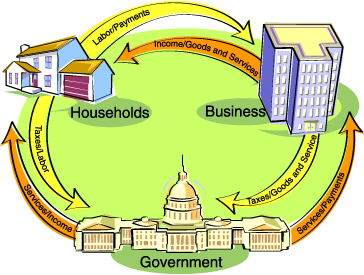
The second way is state control. This involves the government making laws to limit use. A government can say how many fish a boat can catch. It can tax people who pollute the air. These rules force people to consider the cost of their actions. The state acts as a guard for the resource. However, state control has its own set of problems. It can be expensive to watch everyone all the time. Sometimes the rules are not fair. Also, some governments do not have the power to enforce their laws across large areas. This led many thinkers to look for a third way to solve the problem.
The Contribution of Elinor Ostrom
For a long time, people thought only the state or the market could save the commons. Then came the work of Elinor Ostrom. She was a social scientist who studied how real people manage resources. She looked at small towns, Swiss forests, and water systems in Nepal. She found that Hardin’s tragedy is not always a given. Many groups have managed shared resources for hundreds of years without any help from the state or private owners. They did this through community-based management. Ostrom showed that humans are more capable of working together than we often think.
Ostrom found that successful groups follow certain rules. First, they define who can use the resource. Second, they match the rules to the local needs. Third, they ensure that the people using the resource can help change the rules. Most importantly, they have a way to monitor each other. If someone breaks a rule, the group gives them a small fine or a warning. This builds trust within the group. When people trust their neighbors, they are more likely to follow the rules themselves. Ostrom won a Nobel Prize for this work. She proved that local groups can be very good at protecting the things they share.
Modern Challenges and the Global Commons
Today, the tragedy of the commons takes on new forms. One of the biggest challenges is climate change. The earth’s atmosphere is a global common. Every person and every factory releases carbon into the air. No single nation owns the sky. This makes it very hard to stop the rise of global heat. Unlike a small village or a local field, the whole world must agree on how to act. This is much harder to do. We lack a global government with the power to make everyone follow the same rules. International treaties are a start, but they often lack the strength to make a big change quickly.
The digital world also has its own commons. Open-source software and sites like Wikipedia are shared resources. They rely on people to give their time and knowledge for free. If everyone takes information but no one adds to it, the system might fail. Bandwidth on the internet is also a common resource. If a few users take up all the speed, everyone else suffers. We are still learning how to apply the lessons of Hardin and Ostrom to these new spaces. The goal remains the same. We must find a way to balance our own needs with the health of the system we all use.
Conclusion
The tragedy of the commons is a powerful warning. It tells us that doing what seems best for ourselves can lead to a bad result for all. But it is not a story of total despair. Through the work of many thinkers, we have learned how to fight back. We can use smart laws, private rights, or strong community bonds. There is no single answer that fits every case. The best choice often depends on the size of the resource and the people who use it. As we face a future with more people and fewer resources, these lessons are more important than ever. We must learn to see the value in what we share. By working together and making fair rules, we can protect our common world for the generations to come.
Sources
Dietz, T., Ostrom, E., & Stern, P. C. (2003). The struggle to govern the commons. Science, 302(5652), 1907-1912.
Hardin, G. (1968). The tragedy of the commons. Science, 162(3859), 1243-1248.
Lloyd, W. F. (1833). Two lectures on the checks to population. Oxford University Press.
Ostrom, E. (1990). Governing the commons: The evolution of institutions for collective action. Cambridge University Press.
Ostrom, E. (2009). A general framework for analyzing sustainability of social-ecological systems. Science, 325(5939), 419-422.