
Why Hyperinflation Happens: Lessons from History
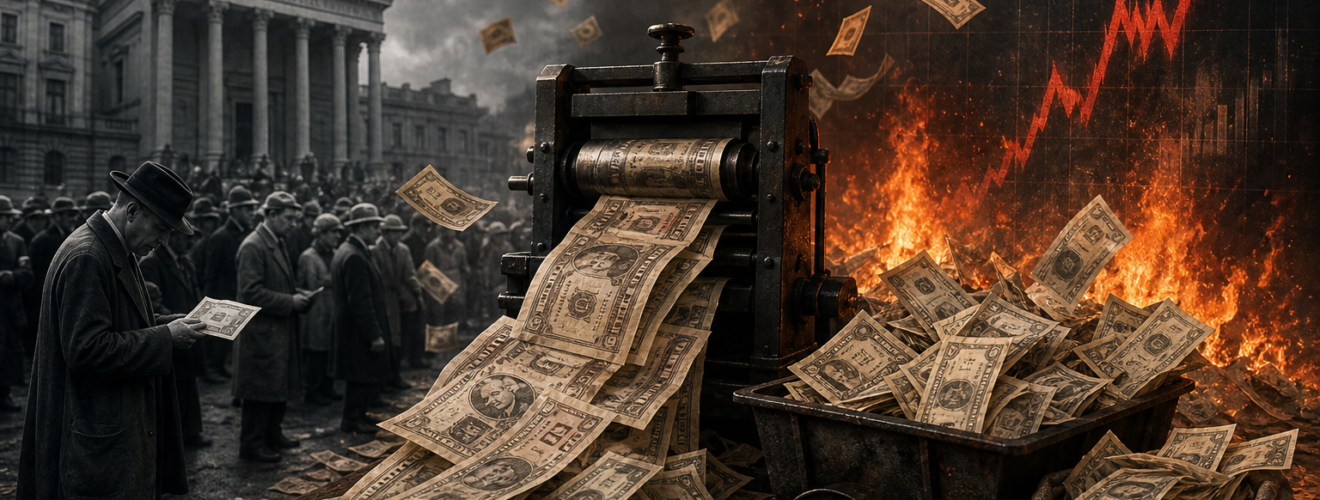
Hyperinflation is a rare but harsh economic event. It is more than just high inflation. It is a total loss of trust in a nation’s money. Most experts define it as a time when prices rise by more than fifty percent in one month. This rate is much higher than the small price hikes we see in healthy economies. When this happens, a currency loses its value fast. People stop saving money. They try to spend their cash as soon as they get it. This behavior makes the problem worse. It creates a cycle that is hard to stop. By looking at history, we can see clear patterns. We can learn why states fall into this trap. We can also see how they might avoid it in the future.
The Core Causes of Rapid Price Growth
The main cause of hyperinflation is a huge increase in the money supply. This usually happens when a government has too much debt. The state may not be able to raise enough tax money to pay its bills. It may also be unable to borrow from other countries. In this case, the government might choose to print more money. This is often seen as an easy fix. However, it leads to a classic supply and demand problem. If there is too much money chasing too few goods, prices will climb. The value of each unit of currency drops. As the value drops, the state must print even more money to buy the same things. This creates a death spiral for the economy.
Another key cause is a sudden drop in the supply of goods. This is known as a supply shock. It often happens during or after a war. It can also happen if a country loses its main source of wealth. For example, a farm crisis or a factory shutdown can limit what is for sale. When there are fewer goods to buy, prices naturally go up. If the government prints money at the same time, the effect is doubled. The economy faces a dual threat. There is too much cash and too little to buy with it. This was a major factor in many historical cases. Trust in the state is the glue that holds a currency together. Once that trust is gone, the currency is just paper.
The Weimar Republic and the Post War Crisis
One of the most famous cases took place in Germany after the first World War. This period is known as the Weimar Republic. Germany had a large debt from the war. They also had to pay big fines to the winning nations. These were called reparations. The German state did not have enough gold or foreign cash to pay these costs. They decided to print marks to buy foreign currency. This led to a fast drop in the value of the mark. By 1923, the situation was out of control. Prices doubled every few days. People brought wheelbarrows full of cash just to buy a loaf of bread. Many people lost their entire life savings in a few months.
This case shows how debt and politics mix. The German people felt the reparations were unfair. The state felt it had no other choice but to print money. However, the move destroyed the middle class. It also led to great social unrest. The lessons from this era are still taught today. It shows that a central bank must be careful with its power. It also shows that war debts can haunt a nation for a long time. The fix for Germany came from a new currency and a new plan for debt. It took a total reset to bring back stable prices. Without a reset, the cycle would have gone on forever.
The Crisis in Zimbabwe and Land Reform
In more recent times, Zimbabwe faced a similar crisis. This started in the late 1990s and peaked in 2008. The causes were slightly different from the German case. In Zimbabwe, the crisis began with land reform policies. These policies led to a sharp drop in farm output. Since the nation relied on crops for trade, the economy shrank. The government also spent a lot of money on a war in a nearby country. To pay for these costs, the central bank printed trillions of dollars. At one point, they even printed a 100 trillion dollar note. This note was barely worth the paper it was printed on.
Prices rose so fast that shops changed them many times a day. Workers would run to the store the moment they were paid. If they waited an hour, their pay might be worth half as much. The people stopped using the local dollar. They turned to the U.S. dollar or the South African rand instead. This is a common end to hyperinflation. The local money dies, and people find a new way to trade. The state eventually had to give up its own currency to stop the pain. This shows that printing money cannot fix a drop in real production. You cannot print your way to a rich nation if you are not making goods.
Venezuela and the Danger of Oil Reliance
Venezuela is another case that we can study today. This nation has some of the largest oil reserves in the world. For a long time, the state used oil wealth to pay for everything. When the price of oil dropped, the state lost its main source of income. Instead of cutting costs, they printed more money. This led to very high inflation. The state also tried to control prices by law. This led to empty store shelves. When the price is set too low, stores cannot make a profit. They stop selling goods. This makes the supply shock even worse.
The Venezuelan case highlights the risk of relying on one commodity. If a nation only sells one thing, it is at risk when that price falls. It also shows that price controls rarely work during a crisis. They often make black markets grow. In a black market, prices are even higher than they would be in a free market. The people of Venezuela faced great hardship. Many left the country to find food and work. This shows that hyperinflation is not just a math problem. It is a human tragedy. It affects health, safety, and the future of an entire generation.
Lessons for Modern Economic Policy
What have we learned from these events? The first lesson is the need for an independent central bank. A central bank should not be controlled by politicians. Politicians often want to spend money to stay popular. They may pressure the bank to print money for their projects. If the bank is independent, it can say no. It can focus on keeping prices stable. This helps maintain trust in the money. Trust is the most important part of any modern economy. Without it, the system falls apart. A bank that is free from political whim is the best guard against hyperinflation.
The second lesson is that fiscal health is vital. A state must keep its debt at a level it can handle. If debt gets too high, the risk of printing money grows. Nations must also keep their economies diverse. Relying on one export, like oil or crops, is dangerous. It makes the state weak to price swings. Finally, states must act fast when inflation starts to rise. If they wait too long, the public loses faith. Once faith is gone, even good policies might fail. History tells us that stable money is the foundation of a peaceful society. We must study these past failures to ensure they do not happen again.
Sources
Cagan, P. (1956). The Monetary Dynamics of Hyperinflation. In M. Friedman (Ed.), Studies in the Quantity Theory of Money (pp. 25-117). University of Chicago Press.
Reinhart, C. M., & Rogoff, K. S. (2009). This Time Is Different: Eight Centuries of Financial Folly. Princeton University Press.
Sargent, T. J. (1982). The Ends of Four Big Inflations. In R. E. Hall (Ed.), Inflation: Causes and Effects (pp. 41-97). University of Chicago Press.