Martial Law (1972): Key Events and Economic Consequences
Martial Law (1972): Key Events and Economic Consequences
The era of Martial Law in the Philippines remains a vital topic in history. It began in September 1972 under President Ferdinand Marcos. This period lasted for over a decade. It changed the political landscape of the nation. It also had a deep impact on the economy. To understand this time, one must look at the events that led to it. We must also look at how the money and resources of the country were managed. This article explores the key moments of that time. It also examines the long-term effects on the wealth of the nation. The goal is to provide a clear view of this complex era.
The Path to Proclamation 1081
In the early 1970s, the Philippines faced many trials. There were many protests in the streets. Students and workers wanted change. At the same time, a communist group was growing in the hills. There was also a conflict in the south. Many people felt the country was in chaos. President Marcos said he needed special powers to restore order. He argued that the state was in danger. He felt that the democratic system could not solve these big problems. This set the stage for a major change in how the country was run.
One major event was the Plaza Miranda bombing in 1971. This happened during a political rally. It killed several people and hurt many more. Marcos blamed the communists for this act. He then suspended the writ of habeas corpus. This meant the police could arrest people without a warrant. Tensions rose even higher across the islands. Many citizens were worried about their future and their safety. The air was filled with fear and doubt as the government took more control.
The final trigger happened on September 22, 1972. There was a reported ambush of the Defense Minister. His name was Juan Ponce Enrile. Marcos used this event to justify his next move. He said the threat to the nation was now too great. He signed Proclamation 1081. This document placed the whole country under Martial Law. The public found out about this on the evening of September 23. By then, the military had already started to act. They took control of many private and public spaces quickly.
The Shutdown of Civil Liberties
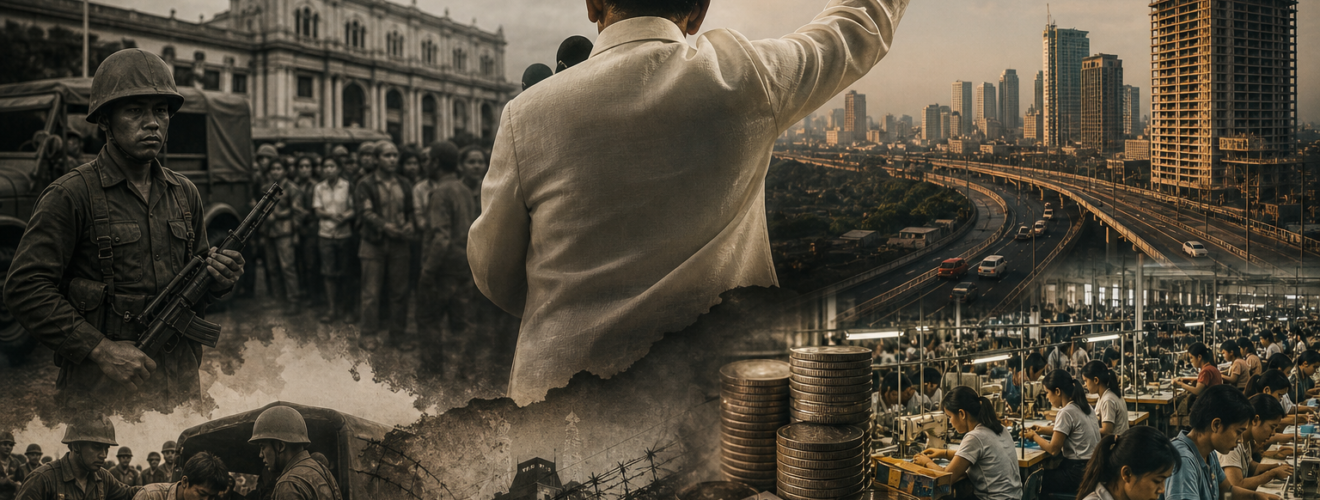
Once Martial Law started, the government took total control of the news. Radio and TV stations were shut down. Newspapers were not allowed to print. The only news people could get came from the state. This allowed Marcos to control what people thought. Many journalists and critics were sent to jail. The government also set a curfew for all citizens. People could not gather in large groups in public. These rules were meant to stop any kind of protest or debate against the new rule.
The military played a huge role in this new system. They were tasked with keeping the peace. However, this often led to the loss of rights. Many people disappeared during this time. Others were hurt or held in prison for years. The legal system changed to favor the president. Marcos could now make laws on his own. He called this the New Society. He promised a more disciplined nation. He said this was the only way to achieve progress for all Filipinos.
Economic Ambitions and the Early Years
In the first few years, the economy seemed to do well. Marcos wanted to build a lot of things. He focused on infrastructure like roads and bridges. He also built large centers for art and health. To pay for these, the country took out many loans from other nations. This brought a lot of cash into the local economy. For a while, the gross domestic product or GDP went up. People saw new buildings rising in the cities. It looked like the country was moving forward fast.
There was also a push for food security. The government started the Masagana 99 program. This was meant to help farmers grow more rice. They used new types of seeds and more chemicals. For a short time, the Philippines stopped buying rice from other countries. It even started to sell rice to others. This was seen as a big win for the New Society. Many people in the provinces felt that things were getting better. However, these gains were not built on a solid base.
The Rise of Crony Capitalism
As time went on, a new problem grew. This is known as crony capitalism. Marcos gave control of big industries to his close friends and family. These people were called his cronies. They were given the rights to run the sugar and coconut trades. They also ran the big phone and power companies. Because they had no real rivals, they did not have to be efficient. They grew very rich while the rest of the country started to struggle. This system hurt the free market.
The sugar and coconut industries are good examples. Millions of farmers relied on these crops. The government set up groups to control the sale of these items. These groups were led by the cronies. They took a large part of the profit for themselves. The farmers stayed poor while the elite stayed wealthy. This caused a lot of anger in the rural areas. It also meant that the economy was not growing in a fair way. The wealth was not reaching the people who did the hard work.
Debt and the Economic Collapse
By the late 1970s, the debt became a heavy burden. The interest on the loans was very high. The global price of oil also went up. This made everything more expensive in the Philippines. The government had to borrow more money just to pay back what it already owed. Soon, the nation was in a debt trap. The money that should have gone to schools and clinics went to foreign banks instead. The growth that people saw earlier began to fade away.
The situation turned into a crisis in 1983. A top political rival, Benigno Aquino Jr., was killed at the airport. This caused a lot of panic in the markets. Foreign banks stopped lending money to the country. Investors took their cash and left. This is called capital flight. The value of the peso fell very low. Prices for food and gas rose quickly. Many people lost their jobs. The economy shrank for two years in a row. This was the worst economic time in the history of the nation.
The Long-Term Legacy
The effects of this era lasted long after 1986. That was the year Marcos was removed from power. The country was left with billions of dollars in debt. It took decades for the nation to pay off these loans. Many believe this held the Philippines back compared to its neighbors. While other countries in Asia grew fast, the Philippines had to fix its broken economy. The poverty rate remained high for a very long time. The gap between the rich and the poor grew wider.
In conclusion, the Martial Law era was a time of great change. It started with a promise of order and growth. It led to some new roads and more rice for a while. But it also led to the loss of freedom and a deep debt. The focus on crony wealth hurt the chance for real progress. Learning about this time helps us understand the current state of the nation. It shows how politics and the economy are tied together. It also reminds us of the value of transparent and fair rule.
Sources
Boyce, J. K. (1993). The Philippines: The Political Economy of Growth and Impoverishment in the Marcos Era. University of Hawaii Press.
De Dios, E. S. (1984). An Analysis of the Philippine Economic Crisis. University of the Philippines Press.
Kushida, K. E. (2003). The Political Economy of the Philippines Under Marcos. Stanford Journal of East Asian Affairs.
Mendoza, R. U. (2016). The Philippine Economy Under Martial Law: A Brief Assessment. Ateneo de Manila University.
Overholt, W. H. (1986). The Rise and Fall of Ferdinand Marcos. Asian Survey, 26(11), 1137-1163.