
Drawing Details in Nature: Observing Plants and Animals
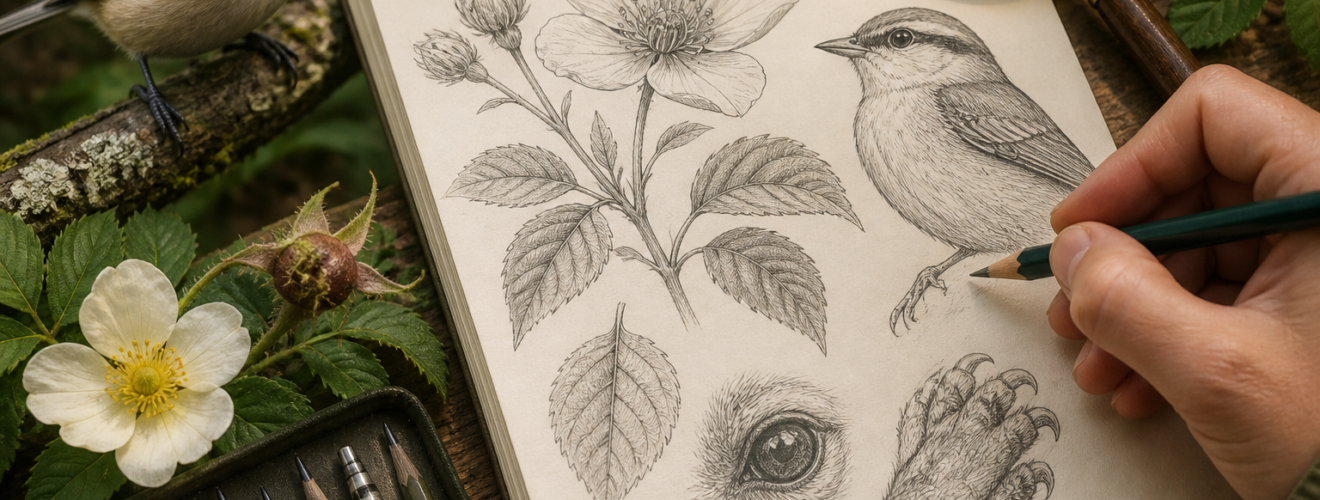
The study of nature often begins with a quiet act of looking. For centuries, scientists and artists have used drawing to understand the world. This practice is more than just making art. It is a vital tool for deep observation. When we sit down to draw a plant or an animal, we start to see things that were hidden before. We notice the way a leaf curves. We see how a bird moves its head. Drawing forces the brain to slow down and process visual data in a new way. This article explores the methods and benefits of drawing details in nature. We will look at how to see better and how to record what we find. By the end, you will see that drawing is a key part of both science and self-growth.
The Psychology of Visual Observation
Many people look at the world, but few truly see it. In our fast-paced life, we often rely on mental shortcuts. If we see a green shape in a park, our brain simply labels it as a tree. We do not stop to look at the bark or the branch patterns. This is often called inattentional blindness. We miss small details because we think we already know what is there. Drawing is the best cure for this habit. When you try to put a shape on paper, you must check its size and angle. You must look back and forth between the object and your page. This process breaks down those mental shortcuts. It forces you to deal with the reality of the specimen.
Professional naturalists use drawing to build a mental map of an organism. Research shows that the act of drawing improves memory. When you draw a flower, you remember its parts much better than if you just took a photo. This is because drawing uses many parts of the brain. You use your eyes to see, your mind to plan, and your hand to move. This creates a strong link in your memory. For a student of nature, this link is very valuable. It turns a brief glance into a lasting piece of knowledge. This is why field journals are still used in the age of digital cameras. A sketch holds the essence of the observer’s focus.
Techniques for Botanical Illustration
Understanding Plant Structure
Plants are wonderful subjects for drawing because they stay still. However, they are also very complex. To draw them well, you should start with the basic structure. Every plant follows a set of growth rules. Some leaves grow in pairs, while others grow one by one. This is called phyllotaxy. Before you draw the fine veins, look at the main stem. How does it bend? How do the branches join the trunk? Use light lines to map out these big shapes first. If the frame of your drawing is wrong, the small details will not look right later on. Think of the plant as a building with a firm frame.
Once the frame is set, look at the shapes of the leaves. No two leaves are exactly the same. Look for small tears or bites from insects. These small flaws make your drawing look real. Avoid the urge to make every leaf perfect. Nature is full of variation. Look at the edges of the leaf too. Are they smooth or do they have teeth? Each species has a unique edge. Capturing these tiny points will make your work look more professional and accurate. It shows that you are a careful observer of the natural world.
Light, Shadow, and Texture
Light is what gives a drawing a sense of three-dimensional space. When drawing plants, notice where the sun hits the surface. The parts of the plant facing the light will be bright. The parts in the back will be dark. Using a range of tones from white to dark grey helps the plant pop off the page. This is very important for round objects like stems or fruits. You can use shading to show the texture of the plant too. Is the stem fuzzy or is it smooth and shiny? Use short, soft marks for fuzz. Use long, clean lines for smooth skin. These small touches tell the viewer how the plant feels to the touch.
Capturing Animal Morphology
The Challenge of Movement
Drawing animals is much harder than drawing plants. Animals move and hide. To draw them, you must learn to work fast. One good way is to start with “gesture drawing.” This means making quick, loose marks to show the action of the animal. If a squirrel is sitting, draw a quick oval for the body and a circle for the head. Do not worry about the fur yet. Focus on the pose. If the animal moves, start a new sketch next to the first one. Over time, you will have a page full of different poses. This helps you understand how the animal’s body works and how it shifts its weight.
Knowledge of basic anatomy is very helpful here. You do not need to be a doctor, but you should know where the joints are. For example, the back leg of a dog or a bird has a joint that looks like a backwards knee. In reality, that is the ankle. Knowing these facts helps you place your lines in the right spots. Even if the animal is covered in thick fur, the bones underneath dictate the shape. If you learn the frame of the skeleton, your drawings will have much more life and truth. It allows you to draw with a sense of structural logic.
Focusing on the Eyes and Face
The eyes are often the most important part of an animal drawing. They are the “soul” of the work. If the eyes look right, the rest of the drawing usually falls into place. Most animals have a small white spot in the eye where the light reflects. This is called the “catch light.” Including this tiny dot makes the animal look alive and alert. Look at the shape of the pupil as well. Cats have slits, while goats have horizontal rectangles. These details tell a story about how the animal lives. They are small clues that help the viewer identify the species and its habits.
The Intersection of Science and Art
Drawing in nature is not just for artists. It is a key part of the scientific method. When a scientist draws a specimen, they are making a record. This record can show things that a photo might hide. A drawing can highlight a specific part of a flower that is tucked away under a petal. It can remove shadows that make a specimen hard to see. This clarity is why drawing is still taught in many biology classes. It helps students learn the parts of a cell or the muscles of a fish. It is a way to prove that the observer has truly understood the form and function of the subject.
Field journaling is a great way to blend these two worlds. A field journal usually has both drawings and notes. You might draw a leaf and then write down the date, the weather, and where you found it. This creates a rich history of your time in nature. Over years, these books become a treasure. They show how the world changes with the seasons. They also show how your own skills as an artist grow. This habit builds a deep sense of place. It makes you a witness to the small wonders of the earth. You become more connected to the land when you take the time to document it by hand.
Conclusion
Drawing details in nature is a journey of discovery. It requires patience, focus, and a willing spirit. While it may seem hard at first, the rewards are great. You gain a better eye for detail and a better memory of the things you see. You learn to appreciate the small things, like the veins in a leaf or the scales on a lizard. This practice bridges the gap between the art world and the scientific world. It turns a simple walk in the woods into a deep study of life. Whether you are a pro or a beginner, picking up a pencil is a great way to know the world. Nature is full of beauty, and drawing is the best way to keep it with you forever.
Sources
Canfield, M. R. (2011). Field notes on science and nature. Harvard University Press.
Laws, J. M. (2016). The Laws guide to nature drawing and journaling. Heyday Books.
Ruskin, J. (1857). The elements of drawing. Smith, Elder & Co.
Tufte, E. R. (1990). Envisioning information. Graphics Press.