What Keeps Us Grounded? Exploring Gravity, Friction, and Energy Transformations
The physical world is a complex place. It is governed by laws that keep everything in its place. We often take for granted the fact that we stay on the ground. We also rely on our ability to move without sliding away. These events are not random. They happen because of forces like gravity and friction. We also see energy change form as we move through our day. This article explores these ideas in clear ways. We will look at how these forces work to keep our world stable. By understanding these concepts, we can better view the world around us. Each force plays a vital role in our daily lives.
The Pull of Gravity
Gravity is the force that pulls objects toward one another. On Earth, this force pulls everything toward the center of the planet. This is why things fall down when we drop them. Gravity is what gives us weight. Without it, we would float off into space. It is a constant force that never stops working. It affects every single object with mass. The more mass an object has, the stronger its pull will be. This is why the Earth has a strong grip on us. The Earth is very large and has a lot of mass.
Newton and the Law of Gravity
Sir Isaac Newton was a famous scientist. He was one of the first to explain how gravity works. He realized that gravity is not just on Earth. It is found all over the universe. Newton wrote that the force depends on two things. These are mass and distance. If you increase the mass of an object, the pull gets stronger. If you move objects further apart, the pull gets weaker. This simple rule helps us track the moon and the stars. It explains why the Earth stays in orbit around the sun. It is a fundamental law of nature.
Weight Versus Mass
Many people think weight and mass are the same. In science, they are quite different. Mass is the amount of matter in an object. It does not change no matter where you are. Your mass is the same on Earth and on the moon. Weight is a measure of the force of gravity on that mass. Because gravity is weaker on the moon, you would weigh less there. However, your body would still have the same mass. Understanding this difference is key to studying physics. It helps us calculate how much force is needed to move an object.
The Resistance of Friction
If gravity pulls us down, friction helps us stay still. Friction is a force that resists motion. it happens when two surfaces touch each other. When you try to slide a box, you feel a push back. That push is friction. It works in the opposite direction of the movement. Friction is very important for many tasks. It allows our shoes to grip the floor. It helps car tires stay on the road. Without it, we would all be sliding around like we were on thin ice. It is a necessary force for stability.
Factors That Affect Friction
Not all surfaces create the same amount of friction. Smooth surfaces like ice have very low friction. This makes it easy to slide across them. Rough surfaces like sandpaper have high friction. The type of material matters a lot. Another factor is how hard the surfaces are pressed together. If you push down on an object, friction increases. This is why a heavy box is harder to slide than a light one. Engineers study these factors to design better tools. They want to find the right balance for each task.
Static and Kinetic Friction
There are two main types of friction to consider. The first is static friction. This is the force that keeps an object from starting to move. You must overcome this force to get something sliding. Once the object is moving, we call it kinetic friction. Usually, it takes more force to start an object moving than to keep it moving. This is because static friction is often stronger than kinetic friction. Understanding these states helps in mechanical design. It helps us know how much power an engine needs to start a car.
Energy Transformations in Motion
Energy is the ability to do work. It exists in many different forms. One of the most important rules is that energy cannot be created or destroyed. It can only change from one form to another. This is called the law of conservation of energy. In our daily lives, we see these changes all the time. When we walk, we turn chemical energy from food into motion. When we use a car, we turn fuel into speed. These changes allow us to interact with our world. They are the reason we can perform any task at all.
Potential and Kinetic Energy
We can group mechanical energy into two types. Potential energy is stored energy. An object has this based on its position. If you hold a ball high in the air, it has potential energy. When you let go, gravity pulls it down. As it falls, that stored energy turns into kinetic energy. Kinetic energy is the energy of motion. Anything that moves has kinetic energy. A fast car has more kinetic energy than a slow one. The switch between these two forms happens constantly in nature. It is a cycle of storage and action.
The Role of Heat
Energy changes are not always perfect. Some energy is often lost as heat. This usually happens because of friction. When you rub your hands together, they get warm. This is because the friction between your hands turns motion into heat. In a car engine, much of the fuel energy becomes heat instead of motion. This is why engines get very hot. Scientists look for ways to reduce this heat loss. By making machines smoother, they can save more energy. This makes our tools more efficient and better for the planet.
A Balanced System of Forces
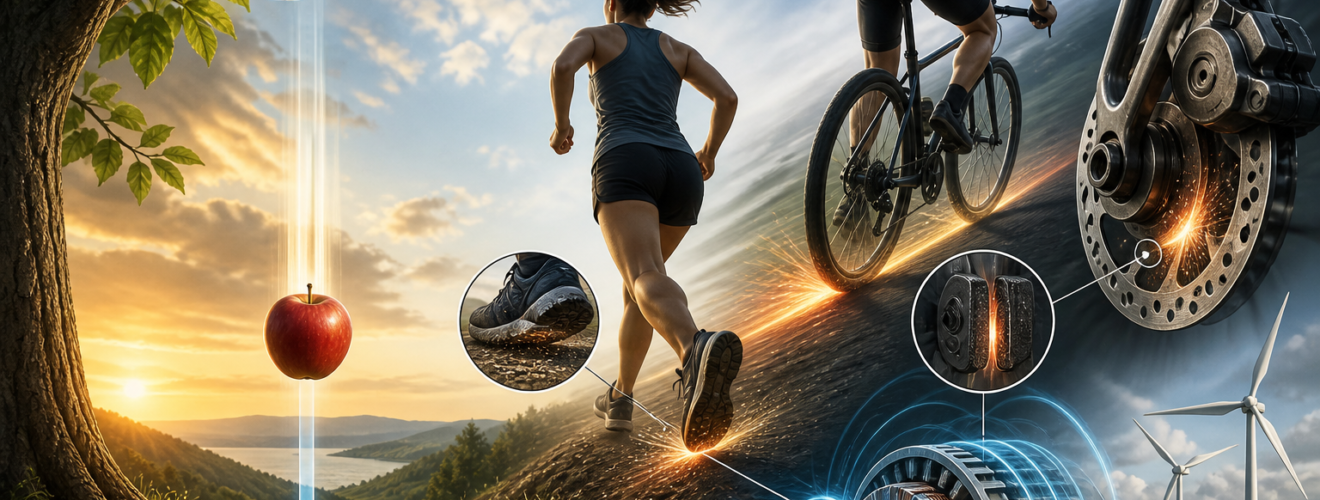
Gravity, friction, and energy all work together. They create a balanced system. Gravity keeps us on the ground. Friction allows us to walk and stop. Energy gives us the power to move. If any of these forces changed, our lives would be very different. We rely on the stability they provide. Scientific study helps us use these forces to our advantage. We build planes that fight gravity. We make brakes that use friction. We create plants that turn wind into power. All of these feats rely on basic physics.
In conclusion, the forces of the world are vital. They are not just ideas in a book. They are real things that affect us every second. Gravity provides a steady pull. Friction provides the grip we need to act. Energy flows from one form to another to drive our actions. By learning about these concepts, we gain a deeper view of life. We can appreciate the fine balance that keeps us grounded. Science is the tool we use to map these unseen paths. It turns the mystery of motion into a clear and useful map for our future.
Sources
Hewitt, P. G. (2014). Conceptual Physics (12th ed.). Pearson.
Knight, R. D. (2016). Physics for Scientists and Engineers: A Strategic Approach (4th ed.). Pearson.
Serway, R. A., & Jewett, J. W. (2018). Physics for Scientists and Engineers (10th ed.). Cengage Learning.
Walker, J. S. (2016). Physics (5th ed.). Pearson.