The Paradox of Thrift: When Saving Hurts the Economy
Understanding the Paradox of Thrift in Modern Economics
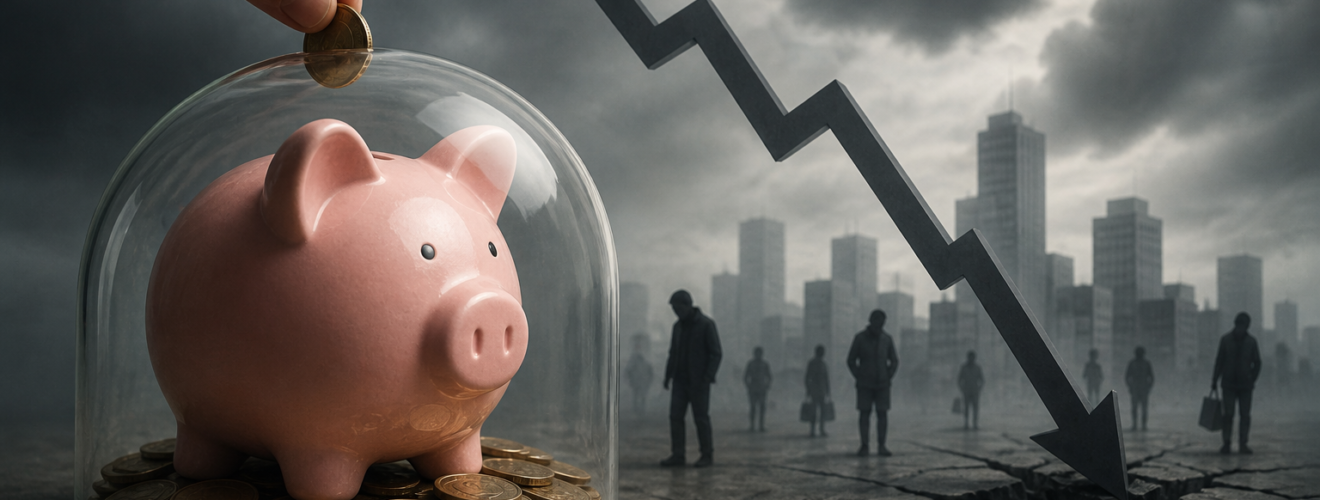
Economic wisdom often starts with a simple rule. This rule states that saving money is good. Most people learn this at a young age. We are told to put money aside for a rainy day. On a personal level, this is sound advice. It builds wealth and provides security. Yet, a famous theory suggests that this rule might not work for a whole nation. This concept is known as the paradox of thrift. It was made popular by the economist John Maynard Keynes. The theory argues that if everyone tries to save more at the same time, everyone may end up worse off. This happens because one person’s spending is another person’s income. When spending stops, the entire economic engine begins to slow down. This article will explore how this paradox works and why it matters today.
The paradox of thrift is a central idea in Keynesian economics. It looks at the link between individual actions and the health of the whole economy. In normal times, saving is a positive act. It provides the funds that banks use to make loans. These loans then help businesses grow. However, the paradox usually appears during a recession. When people fear for their jobs, they stop buying goods. They try to save as much as they can. While this is smart for the individual, it can be a disaster for the market. If everyone stops buying, shops lose money. Those shops then have to lay off workers. Those workers then have less money to spend or save. In the end, the total level of savings in the economy might actually drop. This is why it is called a paradox.
The Core Mechanism of Reduced Consumption
To understand the paradox, we must look at how money moves through a system. Economists often use a model called the circular flow of income. In this model, money moves from households to firms through spending. Firms then pay that money back to households as wages. This cycle keeps the economy stable. When people choose to save more, they take money out of this flow. This is fine if others are taking out loans to spend or invest. But during a crisis, few people want to take out loans. This causes the flow of money to shrink. As the flow shrinks, the total income of the nation falls. This lower income makes it hard for the economy to reach its full potential.
When consumption falls, the demand for goods and services drops. This drop in demand signals to businesses that they should produce less. If a factory makes fewer cars, it needs fewer staff members. This leads to higher rates of unemployment. Unemployment is the main enemy of economic growth. A person without a job cannot save money for the future. They must spend what they have just to survive. Thus, the mass attempt to save more leads to a world where fewer people can afford to save at all. The goal of thrift is to build a better future. But in this case, the act of thrift destroys the very growth that makes a better future possible.
The Multiplier Effect and Economic Decline
The Role of the Multiplier
A key part of this theory is the multiplier effect. This effect shows that a small change in spending can have a big impact on the economy. For example, if a group of people spends one thousand dollars less on clothes, the clothing store loses that income. The store owner then has less money to pay their own bills. They might cancel a contract with a local cleaning service. The cleaning service then has less money to buy fuel. This chain continues through many levels of the economy. A small initial drop in spending can lead to a much larger drop in total national income. The multiplier works in both directions. It can help an economy grow fast, or it can cause a rapid decline during a downturn.
During a period of thrift, the negative multiplier is very strong. Each dollar that is saved instead of spent removes more than a dollar from the total economy. This is why recessions can be so hard to stop once they start. Fear drives people to save, and those savings drive the economy further down. This creates a feedback loop that is hard to break. Economists watch these patterns closely. They want to know when saving shifts from a private virtue to a public problem. Understanding the multiplier helps policy makers decide when they need to step in and help. Without help, the paradox of thrift can turn a small dip into a deep depression.
Historical Examples and the Role of Government
The most famous example of this paradox occurred during the Great Depression. In the 1930s, banks failed and jobs were lost. People responded by saving every penny they could find. They stopped buying everything but the basics. This caused prices to fall, but it also caused more businesses to close. The more people saved, the worse the depression became. It was only when the government started to spend large amounts of money that the cycle broke. By spending on public works, the government put money back into the hands of workers. This increased demand and encouraged people to start spending again. This historical lesson shaped how modern governments respond to crises today.
A more recent example can be seen in the 2008 global financial crisis. When the housing market crashed, many people felt their wealth had vanished. They reacted by cutting back on their spending. This led to a slow recovery in many parts of the world. Central banks tried to fix this by lowering interest rates. They wanted to make saving less attractive and borrowing more attractive. The goal was to get money moving again. In some cases, governments also gave out stimulus checks. These checks were meant to be spent right away. By encouraging spending, the government tried to offset the thrift of the private sector. These actions show that the paradox of thrift is still a major concern for world leaders.
Critiques and Long-Term Perspectives
Not all economists agree with the paradox of thrift. Some argue that saving is always good in the long run. They believe that savings provide the capital needed for investment. Without savings, there would be no money for new technology or infrastructure. These critics often focus on the supply side of the economy. They argue that if interest rates are allowed to move freely, the market will fix itself. If people save more, interest rates should fall. Low interest rates should then make it cheap for businesses to borrow and grow. From this view, the paradox is only a short-term problem. In the long run, more savings lead to more wealth for everyone.
However, the paradox of thrift is mostly about the short term. It describes what happens during a sudden shock to the system. During such times, the normal rules of the market may not work. If businesses are too scared to borrow, low interest rates will not help. This is often called a liquidity trap. In this state, people hold onto cash because they expect things to get worse. This makes the paradox even more dangerous. While saving is vital for long-term health, it can be a poison during a crisis. The challenge for leaders is to find a balance. They must encourage people to save for the future without letting the current economy collapse.
Conclusion: Balancing Thrift and Growth
The paradox of thrift teaches us a vital lesson about how we are all connected. Our personal choices have a wide impact on the world around us. Saving money is a wise choice for a single person. It is a sign of care and planning. But when a whole society tries to save at once, the result can be a shrinking economy. This shows that what is true for one part is not always true for the whole. To keep a nation healthy, there must be a steady flow of spending and investment. We must recognize that the economy depends on the movement of money. If that movement stops, everyone loses. By understanding this paradox, we can better manage the ups and downs of the financial world. We can see that sometimes, the best way to save the economy is to keep it moving forward through active participation in the market.
Sources
Keynes, J. M. (1936). The General Theory of Employment, Interest, and Money. Palgrave Macmillan.
Krugman, P. (2009). The Return of Depression Economics and the Crisis of 2008. W. W. Norton & Company.
Samuelson, P. A., & Nordhaus, W. D. (2009). Economics (19th ed.). McGraw-Hill Education.
Skidelsky, R. (2010). Keynes: The Return of the Master. PublicAffairs.
Stiglitz, J. E. (2012). The Price of Inequality: How Today’s Divided Society Endangers Our Future. W. W. Norton & Company.