
Speed, Velocity, and Sound Waves: The Physics of Motion and Wave Phenomena
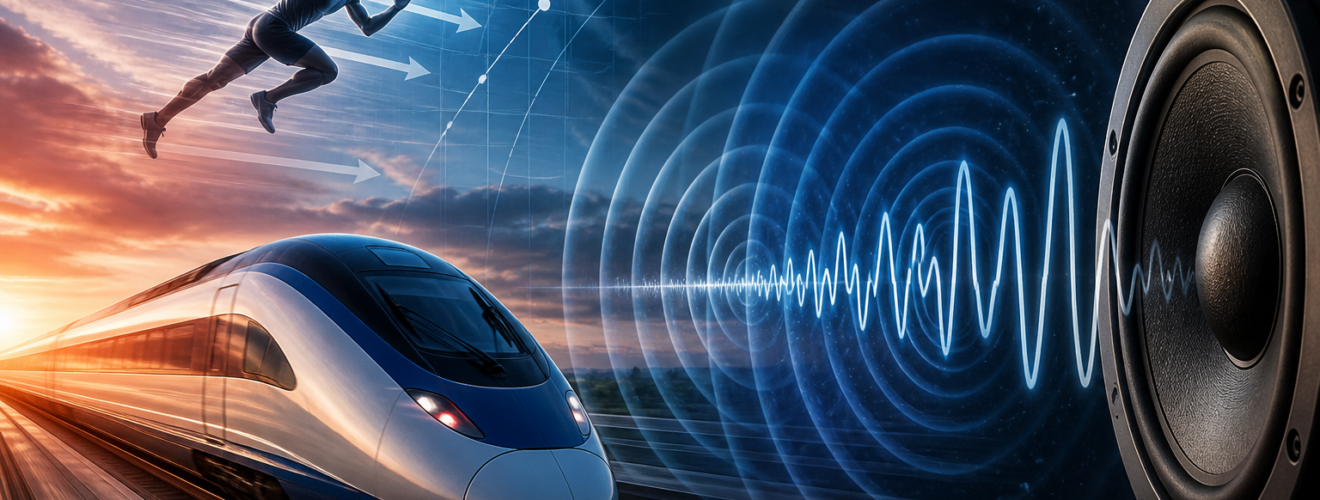
Classical physics provides the foundational framework for understanding how objects move through space and how energy travels through different mediums. The study of motion begins with basic measurements of time and distance. These measurements lead into the complex analysis of waves. This article examines the core principles of speed and velocity. It also looks at the mechanical nature of sound waves. By learning these concepts, we can better understand the physical world. Physics helps us explain why cars move and how we hear music. It is a field built on observation and logic. Every movement we see follows specific rules of nature.
The Fundamentals of Motion: Speed and Velocity
In the realm of physics, speed and velocity are two terms that people often use the same way. However, in a professional scientific context, they represent distinct physical quantities. Speed is a scalar quantity. This means it only tells us how fast an object is moving. It does not specify a direction. If a car moves at sixty miles per hour, we are talking about its speed. Speed is calculated by dividing the total distance by the time it took to travel. This gives us a simple rate of motion. It is easy to measure and easy to understand. Speed is used in many daily tasks, such as driving or running.
Velocity is a vector quantity. This means it includes both speed and a specific direction. For example, a car moving sixty miles per hour to the north has a specific velocity. In physics, direction is just as important as the rate of travel. Velocity allows scientists to track the exact path of an object. If an object changes its direction, its velocity changes. This is true even if its speed stays the same. Understanding velocity is vital for navigation and engineering. Pilots and sailors must know their velocity to reach their goals. Without direction, speed alone is not enough to find a location.
The difference between these two terms is very important in math. When we calculate the net movement of an object, we use velocity. If a person walks ten steps forward and ten steps back, their average speed is positive. However, their average velocity is zero. This is because they ended up exactly where they started. Their displacement was zero. Displacement measures the change in position. In many physics problems, displacement and velocity are the tools we use to solve for time and force. These concepts form the basis for more advanced topics like acceleration and momentum.
The Nature and Properties of Sound Waves
While speed and velocity describe the movement of solid objects, wave mechanics describes how energy moves. Sound is a mechanical wave. This means it requires a medium to travel. Common mediums include air, water, and solid materials like steel. Sound cannot travel through a vacuum because there are no particles to vibrate. In a vacuum, such as outer space, there is total silence. Sound waves move by pushing particles together and pulling them apart. This creates a pattern of pressure. When these patterns reach our ears, we hear sound. The brain turns these pressure changes into the noises we recognize every day.
How Sound Waves Move
Sound waves are longitudinal waves. In a longitudinal wave, the particles of the medium move in the same direction as the wave itself. Imagine a long spring or a slinky. If you push the end of the spring, a pulse travels down its length. The coils move back and forth. This is exactly how sound travels through the air. As a sound wave passes, it creates regions of high pressure called compressions. It also creates regions of low pressure called rarefactions. These waves carry energy from one place to another. They do not carry the actual air particles to a new location. The particles just wiggle back and forth in place.
The Speed of Sound
The speed at which sound travels depends on the medium. In general, sound travels fastest through solids. This is because the atoms in a solid are packed very tightly. The energy can pass from one atom to the next very quickly. Sound travels slower in liquids and slowest in gases like air. Temperature also plays a big role in the speed of sound. In warmer air, particles move faster and have more energy. This allows the sound wave to travel more quickly. At room temperature, the speed of sound in air is about 343 meters per second. This is much slower than the speed of light. This difference in speed is why we see a flash of lightning before we hear the crash of thunder.
Frequency, Pitch, and Amplitude
To describe sound, we use terms like frequency and amplitude. Frequency refers to the number of waves that pass a point in one second. It is measured in Hertz. In music, we call this pitch. High-frequency waves create high-pitched sounds, like a whistle. Low-frequency waves create low-pitched sounds, like a bass drum. Most humans can hear sounds between 20 Hertz and 20,000 Hertz. As people get older, they often lose the ability to hear high-frequency sounds. This is a natural part of aging. Dogs and bats can hear much higher frequencies than humans can. This helps them hunt and navigate.
Amplitude refers to the height or strength of the wave. In sound, amplitude determines the volume. A wave with a large amplitude carries more energy. This results in a louder sound. We measure sound volume in decibels. Very loud sounds can damage the tiny hairs inside our ears. This can lead to permanent hearing loss. It is important to protect our ears from high-decibel environments. Engineers use the study of amplitude to design better speakers and headphones. They also use it to build quiet rooms. By understanding how waves move, we can control the noise in our environment.
The Doppler Effect and Motion
The study of motion and waves comes together in a phenomenon called the Doppler Effect. This effect occurs when a source of sound is moving relative to an observer. You have likely noticed this when an ambulance drives past you. As the ambulance moves toward you, the siren sounds higher in pitch. As it moves away, the pitch drops. This happens because the motion of the vehicle changes the way the sound waves reach your ear. When the vehicle moves toward you, it catches up to the waves it is sending out. This bunches the waves together. Shorter waves mean a higher frequency.
When the vehicle moves away, the waves are spread out over a larger distance. This makes the frequency lower. The Doppler Effect is not just for sound. It also applies to light waves. Astronomers use this to see if stars are moving toward or away from Earth. This is known as red-shift or blue-shift. This concept proves that motion and wave behavior are deeply linked. By measuring the change in frequency, we can calculate the velocity of the moving object. This makes the Doppler Effect a powerful tool in both medicine and space science. It is used in radar guns and ultrasound machines.
Conclusion
Understanding the physics of motion and waves is essential for modern science. Speed and velocity provide the basic language for describing how things move. Sound waves show us how energy travels through our world. These concepts may seem simple, but they govern everything from the flight of a bird to the deep reach of sonar in the ocean. By using clear definitions and careful measurements, scientists can predict the behavior of the physical world. This knowledge allows us to build faster cars, better communication tools, and safer buildings. Physics is the key to unlocking the mysteries of the universe. It turns simple observations into powerful laws of nature.
Sources
Feynman, R. P. (1963). The Feynman Lectures on Physics. California Institute of Technology.
Hewitt, P. G. (2014). Conceptual Physics. Pearson Education.
Walker, J., Halliday, D., & Resnick, R. (2014). Fundamentals of Physics. Wiley.
Young, H. D., & Freedman, R. A. (2019). University Physics. Pearson.