The First Philosophers: How Early Thinkers Shifted Human Awareness
How Early Thinkers Shifted Human Awareness
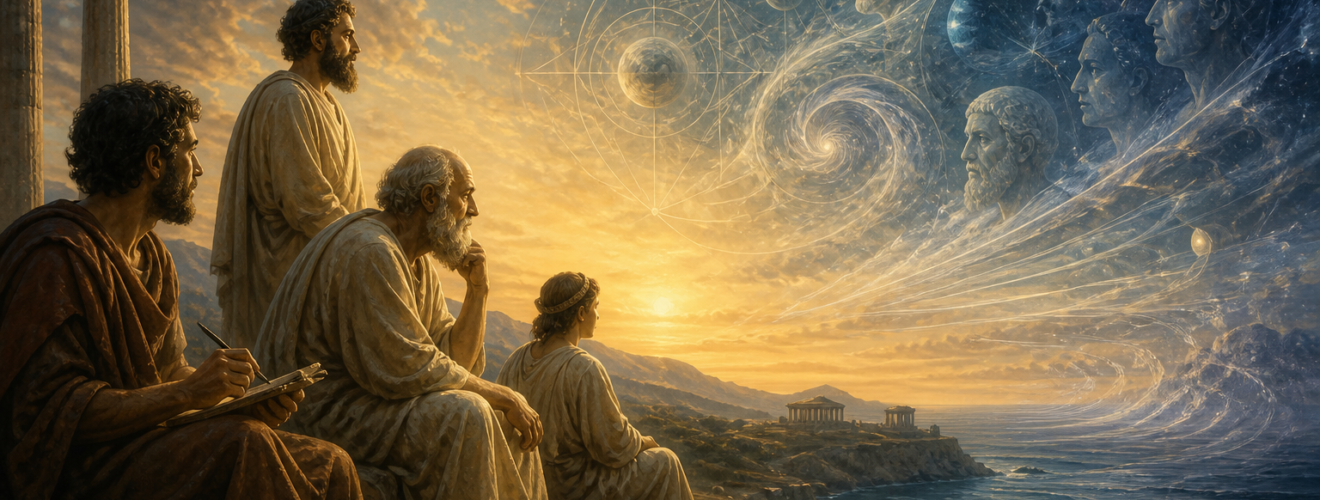
For many centuries, human beings used stories to understand the world. These stories often involved gods, spirits, and magic. If the sea was rough, people believed a god was angry. If the sun rose, they believed a deity was driving a chariot across the sky. This way of thinking is known as mythos. It provided comfort and order, but it did not rely on logic or evidence. Around the sixth century BCE, a major change occurred in the Greek city of Miletus. A group of thinkers began to look for natural causes instead of divine ones. This shift from myth to reason is one of the most important events in human history. It marked the birth of philosophy and the early roots of science.
The move toward rational thought changed how humans saw their place in the universe. Instead of being passive subjects of the gods, humans became observers. They realized that the mind could uncover the secrets of nature. These early thinkers are called the Pre-Socratics. They did not just want to know what happened; they wanted to know why it happened. They sought a single, basic substance that could explain the variety of the world. This search for unity in diversity was a new way to use the human brain. It shifted awareness from the supernatural to the material. It taught us that the world is a place of laws rather than whims.
The Milesian School: Finding the First Cause
The first major school of thought emerged in Miletus, a busy center of trade. Trade allowed for the exchange of not only goods but also ideas. People from Egypt, Babylon, and Greece met and shared their knowledge. This mixing of cultures encouraged people to question their own traditions. The Milesian thinkers were the first to propose that the world had a physical origin. They looked for the “arche,” or the first principle of all things. They wanted to find the one substance that remains the same even when things appear to change. This was the first time in history that anyone tried to explain the universe through physics rather than poetry.
Thales and the Power of Water
Thales of Miletus is widely known as the first philosopher. He was a man of many talents who studied the stars and the seasons. He famously predicted a solar eclipse, which proved that celestial events followed a pattern. Thales proposed that the primary substance of the world was water. This idea may seem simple today, but it was a massive step forward. Thales observed that water is essential for all life. He saw that it could exist in three states: solid ice, liquid water, and gaseous steam. By choosing water, he was saying that the world is made of something we can see and touch. He moved the source of truth from the heavens down to the earth.
Anaximander and the Boundless
A student of Thales named Anaximander took this idea even further. He argued that if the primary substance was water, then fire could not exist, as water destroys fire. He believed the source of all things must be more neutral. He called this source the “Apeiron,” which means the Boundless or the Unlimited. The Apeiron was an abstract concept. It was an eternal and moving force that gave birth to all opposites, such as hot and cold or wet and dry. Anaximander was the first to use such an abstract idea to explain reality. He also suggested that humans evolved from fish-like creatures. His work showed that human awareness was becoming more complex and capable of deep theory.
Anaximenes and the Breath of Life
The third great Milesian thinker was Anaximenes. He brought the focus back to a material substance, but he chose air. He believed that air was the most basic element because it is always in motion and supports life. He developed a theory to explain how air turns into other things. He argued that when air is thinned, it becomes fire. When it is thickened, it becomes wind, then clouds, then water, and finally earth and stone. This was a vital step because it introduced the idea of change through quantity. It suggested that all the different things we see are just different densities of the same stuff. This paved the way for future scientific laws regarding matter and energy.
The Debate Over Change: Heraclitus and Parmenides
As philosophy grew, thinkers began to tackle the problem of change itself. They noticed that the world is always shifting, yet it also seems to stay the same. This led to a famous debate between two thinkers with very different views. This debate forced humans to think about the nature of reality and the reliability of their senses. It was a shift toward metaphysics, which is the study of what truly exists. These two thinkers, Heraclitus and Parmenides, set the stage for all future Western logic. Their ideas were so powerful that they still influence how we see the world today.
Heraclitus and the Constant Flow
Heraclitus of Ephesus believed that change was the fundamental truth of the universe. He famously stated that a person cannot step into the same river twice. This is because the water is always moving, and the person is also changing. For Heraclitus, the world was like a fire that is always burning. He believed that everything exists in a state of tension between opposites. He argued that conflict is necessary for life and that unity comes from balance. He called the logic behind this balance the “Logos.” To Heraclitus, human awareness must recognize that nothing is permanent. We must learn to see the hidden harmony in a world that never stops moving.
Parmenides and the Reality of Being
Parmenides of Elea held the exact opposite view. He argued that change is an illusion created by our senses. He used pure logic to claim that what “is” cannot come from what “is not.” Therefore, nothing can ever truly begin or end. If something exists, it has always existed and will always exist. To Parmenides, reality is solid, unchanging, and perfect. He taught that we should not trust our eyes or ears because they deceive us. Instead, we must trust only our reason. This was a major shift in awareness because it separated the physical world from the world of the mind. It laid the foundation for formal logic and the study of being.
The Atomist Solution: A New View of Matter
Later thinkers tried to find a middle ground between the flow of Heraclitus and the stasis of Parmenides. The most successful were the Atomists, led by Democritus. They proposed that the world is made of tiny, invisible, and indivisible particles called atoms. These atoms are eternal and unchanging, which satisfied the logic of Parmenides. However, these atoms move through an empty space called the void. By moving and joining together, they create the changing world that Heraclitus described. This was a brilliant solution to a difficult problem. It suggested that the world is a giant machine made of small parts. This view of the world is very close to our modern scientific understanding.
The Lasting Impact on Human Awareness
The first philosophers did not just give us new facts. They gave us a new way to live. By moving away from myth, they allowed humans to take responsibility for their own knowledge. They taught us to ask for proof and to use our minds to solve problems. This shift allowed for the growth of medicine, math, and political science. It also led to a sense of wonder about the natural world that does not require magic. We are still the heirs of these early thinkers. Every time we conduct a scientific test or use logic to settle a debate, we are following in their footsteps. They shifted human awareness from a state of fear and mystery to a state of curiosity and reason.
In conclusion, the Pre-Socratic thinkers were the pioneers of the human mind. They dared to ask big questions about the origin and nature of the universe. They looked at the stars and saw patterns rather than gods. They looked at the earth and saw a system of laws. While many of their specific theories have been updated, their basic approach remains the core of modern thought. They showed us that the universe is a place we can understand. By doing so, they opened the door to a future where knowledge is the most valuable tool we have. Their legacy is the very foundation of the modern world.
Sources
Burnet, J. (1930). Early Greek philosophy. A. & C. Black.
Curd, P. (2020). Presocratic philosophy. In E. N. Zalta (Ed.), The Stanford Encyclopedia of Philosophy. Stanford University.
Guthrie, W. K. C. (1962). A history of Greek philosophy: The earlier Presocratics and the Pythagoreans (Vol. 1). Cambridge University Press.
Kirk, G. S., Raven, J. E., & Schofield, M. (1983). The Presocratic philosophers: A critical history with a selection of texts. Cambridge University Press.